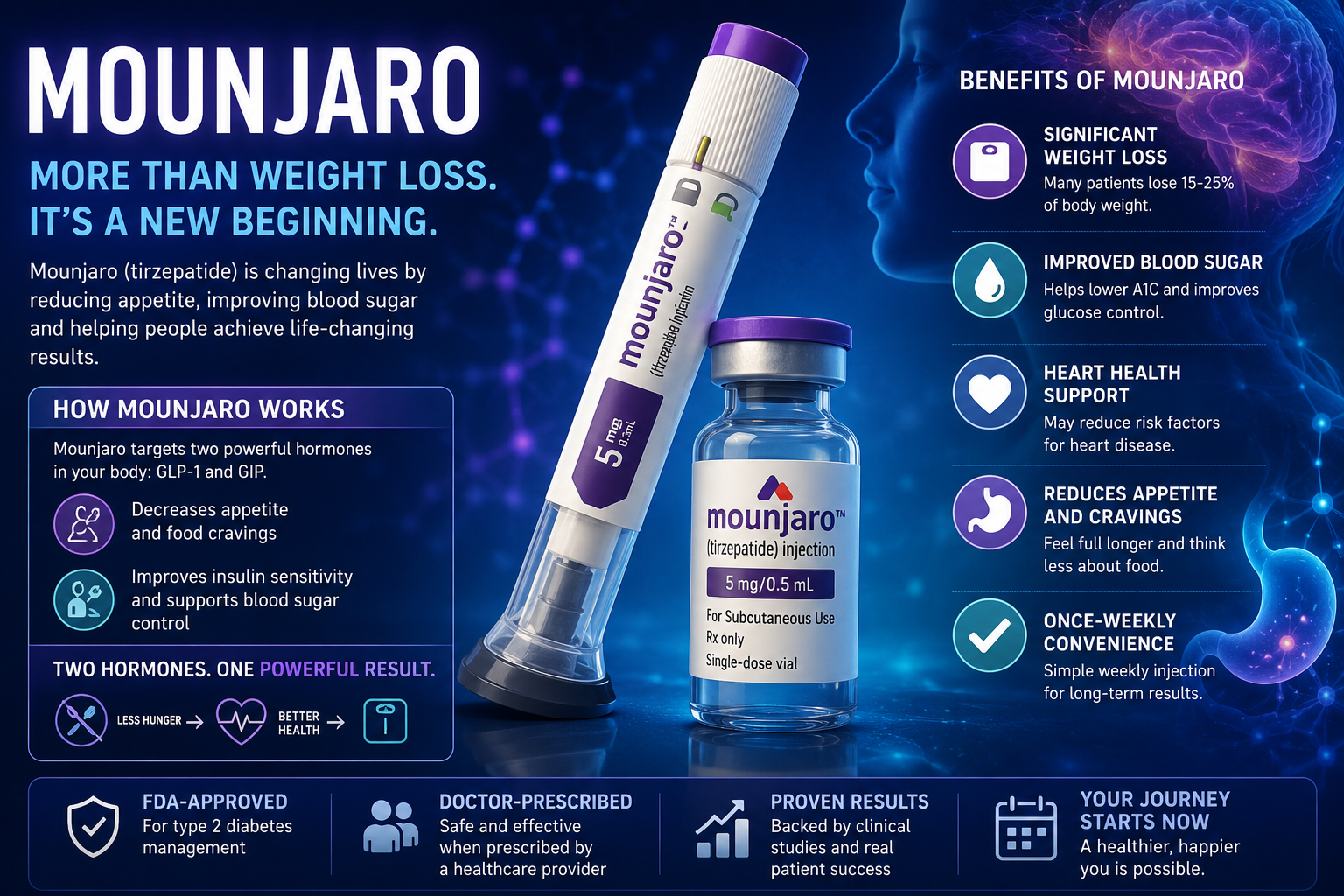
Mounjaro and GLP-1 medications may be transforming food industries, healthcare, fitness culture, and the global economy faster than most people realize.

Georgie Jonte

At first, Mounjaro looked like just another medical breakthrough.
A weekly injection helping people lose weight.
But something unusual started happening.
Entire industries began paying attention.
Not just hospitals.
Not just doctors.
Not just pharmaceutical companies.
Restaurants.
Airlines.
Fitness brands.
Snack companies.
Investors.
Economists.
Why?
Because when millions of people suddenly begin eating less, shopping differently, and changing long-term habits, the ripple effects spread far beyond healthcare.
And that’s exactly what may already be happening.
Some analysts are now calling it:
“The Ozempic Economy.”
A new economic shift driven by GLP-1 medications like Mounjaro that could reshape consumer behavior worldwide.
The implications may become far larger than weight loss itself.
One of the earliest patterns researchers noticed was surprisingly simple:
People using GLP-1 medications often stopped buying as much food.
Many users reported:
At first, these sounded like individual lifestyle changes.
But then millions of people started reporting similar experiences.
That’s when economists began asking a much larger question:
What happens to the economy when appetite itself changes?
Modern food industries were built around maximizing consumption.
Bigger portions.
More snacks.
More cravings.
More convenience.
For years, companies competed aggressively for human attention and appetite.
But Mounjaro may disrupt that model at the biological level.
If consumers naturally desire less food:
Some major food corporations are already closely monitoring the rise of GLP-1 medications.
Because even small behavioral changes become massive at scale.
If millions of consumers begin eating differently, entire industries may eventually need to adapt.
The financial world has become deeply interested in GLP-1 medications.
Investors are now analyzing how these drugs could affect:
Some analysts believe medications like Mounjaro may become one of the biggest healthcare trends of the decade.
Not just because people are losing weight.
But because metabolic health affects nearly every part of society.

Mounjaro users often begin making broader lifestyle changes after losing weight.
Many report:
This creates a new kind of consumer:
the health optimization consumer.
Instead of spending primarily on indulgence, future spending patterns may increasingly focus on:
The wellness industry itself may evolve dramatically over the next decade.
If appetite-regulating medications become more common, restaurants may eventually shift strategies entirely.
Future dining trends may prioritize:
Some futurists believe oversized portions may eventually feel outdated.
Instead of eating for sheer volume, future consumers may increasingly eat for:
Food culture itself could slowly evolve.

One of the strangest ripple effects involves travel industries.
Why?
Because obesity affects:
Some analysts speculate widespread weight reduction could eventually influence:
While these changes would happen gradually, they highlight how deeply metabolic health affects society.
GLP-1 medications have triggered intense competition among pharmaceutical companies.
Researchers are now racing to develop:
This could become one of the most profitable healthcare markets in modern history.
Why?
Because obesity affects hundreds of millions of people globally.
And unlike short-term treatments, many experts believe metabolic therapies may become long-term healthcare tools.
Weight loss culture online is already changing.
For years, social media revolved around:
Now the conversation is shifting toward:
Mounjaro may eventually change not just bodies —
but internet culture itself.
Despite the excitement, major concerns remain.
One of the biggest issues is access.
If advanced metabolic treatments remain expensive, society could face a new form of health inequality.
People with access to:
may experience dramatically different long-term health outcomes compared to those without access.
Some experts fear the future could create:
“metabolic class divides.”
Where biology itself becomes increasingly optimized based on wealth.

Mounjaro may ultimately become far more than a successful weight loss medication.
It may represent the beginning of a much larger transformation involving:
For the first time in history, millions of people are experiencing what life feels like when appetite no longer dominates daily decision-making.
And when human behavior changes at scale, entire societies change with it.
The future impact of GLP-1 medications may not simply be measured in pounds lost.
But in how they quietly reshape the modern world around us.
Browse expert reviews, guides, and comparisons across all our health categories.
GLP-1 medications, nutrition plans & more
Therapy, psychiatry & counseling
ED, testosterone, hair loss & wellness
Birth control, hormones & fertility
Cold, flu, infections & quick visits
Check-ups, chronic care & prescriptions
Men's Health
Hormone replacement for men with low testosterone. Improves energy, mood, muscle mass, and libido.
Explore our latest articles, guides, and expert insights on telehealth and wellness.
Real stories from real patients who found better healthcare through CompareTelehealth.
"CompareTelehealth made finding the right provider so easy. I was matched with a doctor in minutes and had my prescription the same day."
Sarah M., 34
Austin, TX
"I've been managing my diabetes through telehealth for 6 months now. My provider is thorough, caring, and always available when I need her."
James K., 52
Chicago, IL
"Got my birth control prescription renewed in a 10-minute video call. No waiting room, no hassle. This is how healthcare should work."
Emily R., 28
Denver, CO
"Was skeptical about online therapy but my therapist is incredible. We meet weekly via video and it's been life-changing for my anxiety."
Marcus W., 41
Miami, FL
"Lost 28 pounds with my telehealth weight loss provider. The personalized plan and medication support made all the difference."
Priya N., 31
Seattle, WA
"Had a sinus infection on a Sunday night. Got on a video call in 15 minutes, had antibiotics at my pharmacy by Monday morning."
David L., 45
Phoenix, AZ
"The comparison tool helped me find the most affordable provider for my needs. Saved over $200 compared to my previous telehealth service."
Rachel T., 38
Brooklyn, NY
"At my age, having a doctor who actually listens matters. My telehealth primary care provider gives me more attention than any in-person doctor."
Tom H., 61
Nashville, TN
"CompareTelehealth made finding the right provider so easy. I was matched with a doctor in minutes and had my prescription the same day."
Sarah M., 34
Austin, TX
"I've been managing my diabetes through telehealth for 6 months now. My provider is thorough, caring, and always available when I need her."
James K., 52
Chicago, IL
"Got my birth control prescription renewed in a 10-minute video call. No waiting room, no hassle. This is how healthcare should work."
Emily R., 28
Denver, CO
"Was skeptical about online therapy but my therapist is incredible. We meet weekly via video and it's been life-changing for my anxiety."
Marcus W., 41
Miami, FL
"Lost 28 pounds with my telehealth weight loss provider. The personalized plan and medication support made all the difference."
Priya N., 31
Seattle, WA
"Had a sinus infection on a Sunday night. Got on a video call in 15 minutes, had antibiotics at my pharmacy by Monday morning."
David L., 45
Phoenix, AZ
"The comparison tool helped me find the most affordable provider for my needs. Saved over $200 compared to my previous telehealth service."
Rachel T., 38
Brooklyn, NY
"At my age, having a doctor who actually listens matters. My telehealth primary care provider gives me more attention than any in-person doctor."
Tom H., 61
Nashville, TN
Everything you need to know about CompareTelehealth and how we help you find better healthcare.
CompareTelehealth is a platform that helps you find, compare, and connect with the best telehealth providers for your specific health needs — from weight loss and mental health to urgent care and primary care. We provide unbiased reviews, pricing comparisons, and expert guides to help you make informed healthcare decisions.
No, we are not a telehealth provider ourselves. We are an independent comparison and review platform. We help you discover and compare licensed telehealth providers so you can choose the one that's right for you based on cost, ratings, availability, and services offered.
CompareTelehealth is completely free to use. You can browse reviews, compare providers, read guides, and access all our content at no cost. You only pay when you choose to book a visit with a telehealth provider through their platform.
We cover a wide range of telehealth services including weight loss (GLP-1 medications), mental health & therapy, women's health (birth control, PCOS, menopause), men's health (ED, hair loss, testosterone), urgent care, and primary care. New categories are added regularly.
Yes, all telehealth providers featured on our platform are licensed, board-certified medical professionals. We verify credentials and only list reputable, established telehealth services that meet our quality standards.
Yes, most telehealth providers we compare can prescribe medications during your virtual visit. Prescriptions are typically sent directly to your preferred pharmacy or delivered to your door, depending on the provider and medication type.
Many insurance plans now cover telehealth visits, though coverage varies by provider and plan. We include insurance acceptance information in our provider comparisons so you can find options that work with your coverage. Some providers also offer affordable self-pay rates.
Use our comparison tools to filter providers by specialty, cost, availability, ratings, and insurance acceptance. We also publish detailed guides and reviews to help you understand what each provider offers. If you're unsure, start with our 'How to Choose' guides in each category.
For many conditions, telehealth is equally effective as in-person care. Studies show high patient satisfaction and comparable outcomes for conditions like mental health, chronic disease management, medication management, and routine check-ups. However, some conditions still require in-person evaluation — we clearly note when that's the case.
You can reach our team through the contact form on our About Us page, or email us directly. We're here to help you navigate your telehealth options and answer any questions about the providers and services we compare.