Every generation experiences a technological shift so massive that life before it eventually feels ancient.

The internet changed communication.
Smartphones changed attention spans.
Artificial intelligence is changing work itself.

But a quieter revolution may already be happening inside the human body.

Its name is Mounjaro.

At first glance, it looks simple:
a weekly injection designed to help with blood sugar and weight loss.

But beneath the surface, scientists are beginning to realize something extraordinary:

This may be the first mainstream medication capable of fundamentally changing humanity’s relationship with hunger.

Not temporarily.
Not psychologically.
Biologically.

For thousands of years, humans have lived under the control of appetite. Entire civilizations were shaped by food scarcity, famine, agriculture, trade routes, survival instincts, and calorie storage.

Now, for the first time in history, millions of people are reporting something almost impossible:

They simply are not hungry anymore.

And if that trend continues, the long-term consequences may reach far beyond weight loss.

We may be witnessing the beginning of the first post-obesity society.

The Ancient Survival System Inside Your Brain

To understand why Mounjaro feels so revolutionary, we first need to understand how ancient the hunger system truly is.

Human beings evolved during periods where starvation was a constant threat. The brain developed survival mechanisms designed to maximize calorie intake whenever food became available.

This is why humans naturally crave:

  • sugar
  • fat
  • salt
  • high-calorie foods

Our ancestors who aggressively sought calories survived longer.

The problem is:
modern society no longer resembles the environment humans evolved for.

Today:

  • ultra-processed foods are everywhere
  • portions are massive
  • stress levels are constant
  • sleep quality is poor
  • physical activity is lower than ever

The ancient survival brain never adapted.

Mounjaro may be one of the first medications capable of interrupting this evolutionary mismatch.

And that changes everything.

The Silence Users Cannot Stop Talking About

One of the strangest things about Mounjaro is that users often describe the experience emotionally rather than physically.

People rarely say:
“I just eat less.”

Instead, they say:

  • “The cravings disappeared.”
  • “My brain feels quiet.”
  • “Food stopped controlling me.”
  • “I forgot to eat.”
  • “I finally feel normal.”

This phenomenon has become widely known online as “food noise reduction.”

For many people, the most exhausting part of obesity was never just the weight itself.

It was the constant mental battle.

The endless internal dialogue:

  • What should I eat?
  • Should I snack?
  • Why am I still hungry?
  • I’ll start over tomorrow.
  • Just one more bite.

Then suddenly:
silence.

For some users, the emotional impact feels almost life-changing.

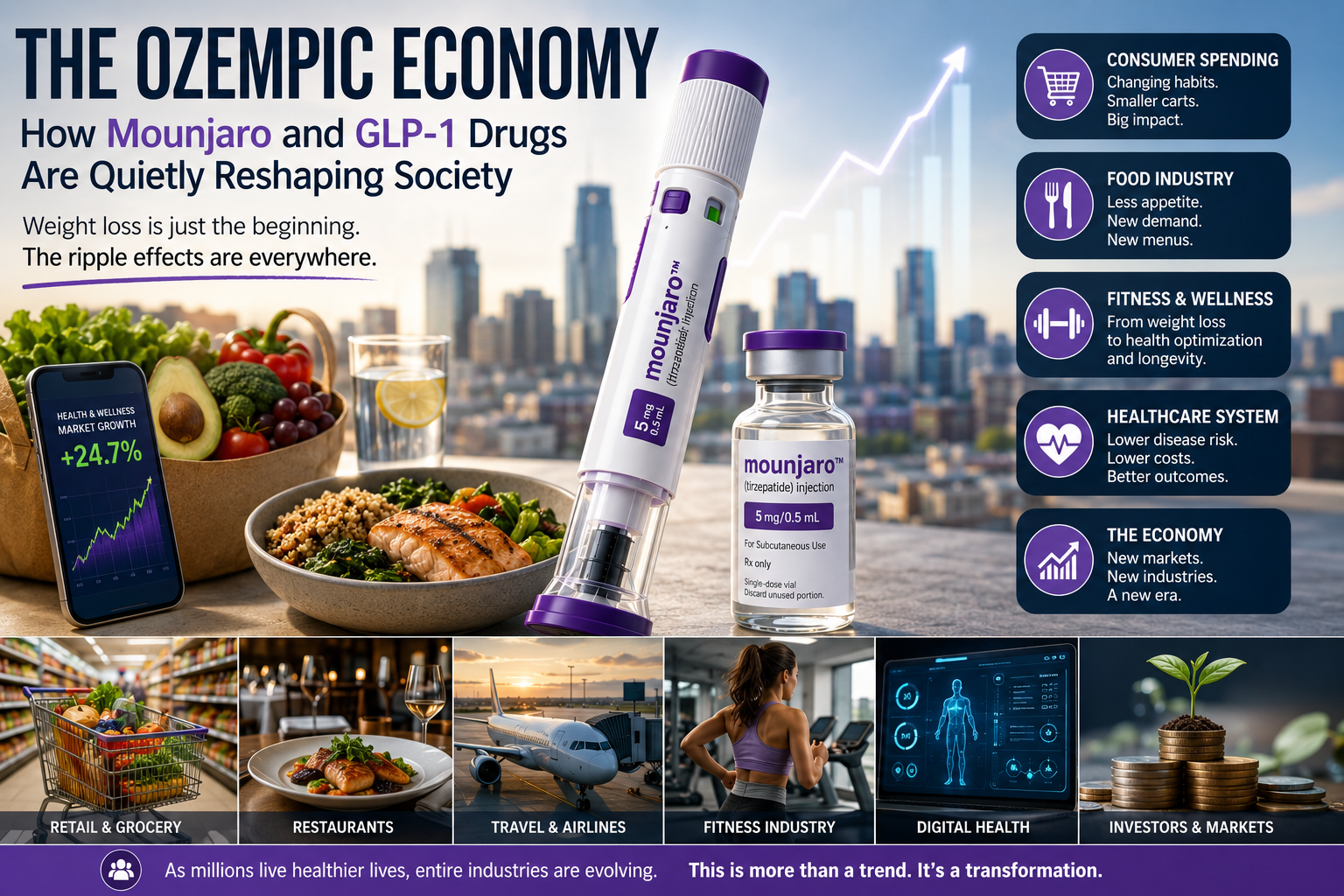
The Economic Shock Nobody Saw Coming

If millions of people begin eating significantly less food, entire industries may be forced to adapt.

That may sound dramatic.

But economists are already watching the rise of GLP-1 medications carefully.

Why?

Because reduced appetite changes spending behavior.

Some Mounjaro users report:

  • buying fewer snacks
  • eating out less often
  • reducing alcohol consumption
  • avoiding impulse purchases
  • shopping differently at grocery stores

If these patterns continue globally, the economic impact could become enormous.

Industries potentially affected include:

  • fast food chains
  • soda manufacturers
  • snack brands
  • processed food companies
  • restaurants
  • alcohol companies
  • diet programs

The modern food economy was built around maximizing consumption.

What happens if consumers biologically desire less?

That question alone could reshape trillion-dollar markets.

The Rise of Metabolic Class Divides

Not everyone will have equal access to advanced weight-loss medications.

And that creates another possibility:

future metabolic inequality.

Imagine a world where wealthy individuals have access to:

  • appetite-regulating medications
  • personalized nutrition AI
  • genetic optimization
  • longevity therapies
  • advanced preventative healthcare

Meanwhile, lower-income populations continue struggling with obesity, processed foods, and metabolic disease.

Some experts fear future society could develop a new kind of health divide:
not just economic class,
but biological optimization class.

The people who can afford enhancement versus the people who cannot.

This could eventually influence:

  • lifespan
  • productivity
  • healthcare costs
  • insurance
  • social mobility

Mounjaro may be only the first wave.

Could Hunger Eventually Become Optional?

This idea sounds almost science fiction.

But scientists are already exploring:

  • longer-lasting GLP-1 therapies
  • oral alternatives
  • combination appetite drugs
  • genetic metabolic treatments
  • brain-targeted hunger regulation

If these technologies continue advancing, future generations may grow up in a world where severe obesity becomes increasingly rare.

In the distant future, overeating itself could become medically preventable.

That raises massive ethical questions:

  • Should appetite be medically controlled?
  • Could society pressure people into using these drugs?
  • Will body standards become harsher?
  • Could natural hunger eventually be viewed as a “medical issue”?

Humanity may eventually need entirely new ethical frameworks around body autonomy and enhancement medicine.

The Unexpected Psychological Effects

Rapid body transformation changes more than appearance.

Many users describe:

  • identity shifts
  • altered confidence
  • relationship changes
  • emotional confusion
  • social anxiety disappearing
  • attention from strangers increasing

Some even experience grief.

Why?

Because obesity often becomes deeply tied to identity over decades.

When that identity suddenly changes, the psychological effects can feel disorienting.

Future mental health professionals may need specialized therapy models for post-weight-loss identity adaptation.

That may sound extreme today.

But dramatic body transformation used to be rare.

Now it may become common.

Are We Watching the Beginning of Human Biological Upgrades?

For most of history, medicine focused on treating disease after it appeared.

But modern healthcare is beginning to shift toward optimization instead of survival.

Mounjaro may represent one of the earliest mainstream examples of this transition.

Not survival medicine.

Enhancement medicine.

And that opens the door to much larger possibilities.

Future generations of treatments may target:

  • aging
  • focus
  • memory
  • stress tolerance
  • emotional regulation
  • addiction
  • sleep optimization
  • motivation

Human biology itself may become increasingly customizable.

If that happens, historians may eventually look back at GLP-1 medications as one of the first major milestones in the era of engineered human metabolism.

The Strange Future of Food Culture

Food has always been emotional.

Celebration.
Comfort.
Tradition.
Family.
Identity.

But what happens when millions of people simply stop feeling strong cravings?

Future generations may treat food differently:

  • smaller portions
  • functional nutrition
  • protein-focused meals
  • eating for performance instead of pleasure
  • reduced emotional attachment to food

The culture surrounding eating itself could evolve dramatically.

Some futurists even predict restaurants may shift toward immersive experiences rather than oversized meals.

Food may become less about quantity and more about optimization.

Final Thoughts

Mounjaro may ultimately become far more important than a successful weight loss medication.

It could represent the beginning of humanity learning how to override one of its oldest biological survival systems.

Hunger shaped civilizations.
Agriculture shaped empires.
Food shaped human history itself.

Now, for the first time, technology may be allowing humans to partially disconnect from the ancient instincts that controlled us for thousands of years.

And if this is only the first generation of metabolic medicine, the future ahead may look completely unrecognizable compared to the world we live in today.

Not just thinner.

Different.

Effectiveness of Telehealth in OB-GYN Care: How Virtual Medicine Is Reshaping Women’s Health in 2025

April 21, 2026

Mounjaro for Weight Loss: Complete Beginner’s Guide (2026)

May 25, 2026

Best GLP-1 Products for Weight Loss in 2026: Compare Options, Benefits, and Risks

April 27, 2026

When Should You See a Doctor for ED? A Telehealth Guide for 2026

April 9, 2026

Best Online Weight Loss Clinics for GLP-1 Medications

May 11, 2026

The New Age of Healthcare in 2025: Why Telehealth Is Here to Stay

April 21, 2026